
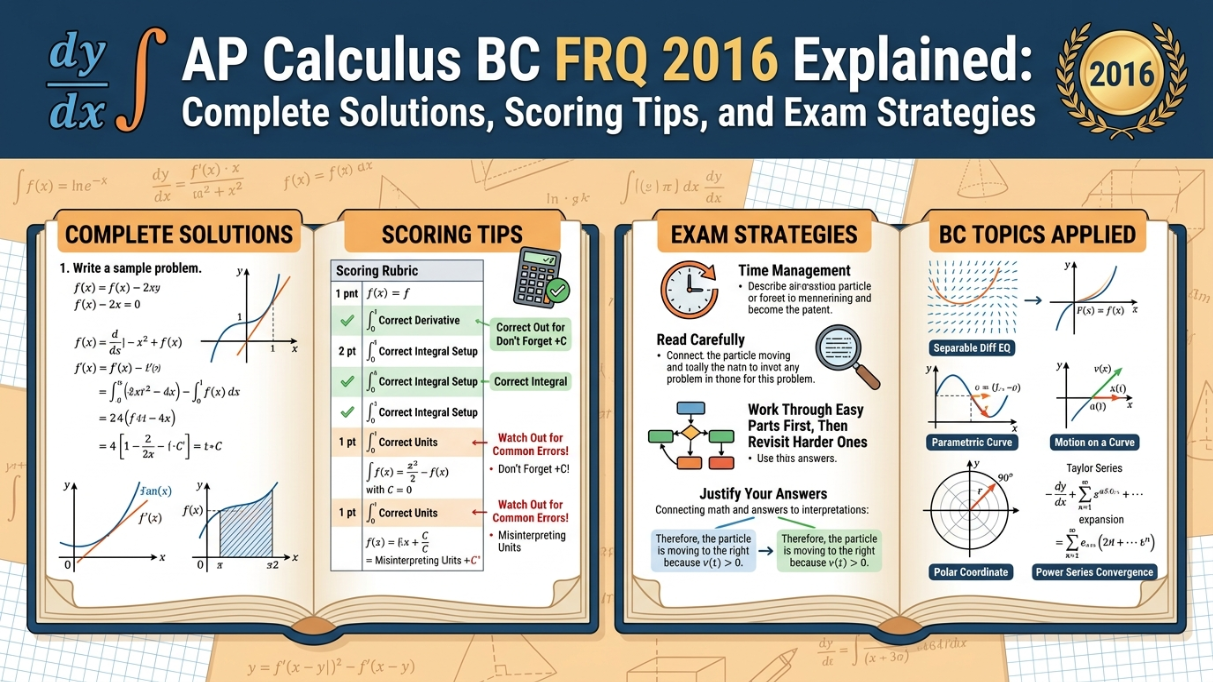

The AP Calculus BC FRQ 2016 remains one of the most valuable resources for students preparing for the AP Calculus BC exam. Free-response questions (FRQs) are designed to evaluate much more than memorization. They measure your ability to apply calculus concepts, justify mathematical reasoning, interpret graphs, and communicate solutions clearly.
Whether you are reviewing for an upcoming AP exam or learning from past assessments, studying the AP Calculus BC FRQ 2016 helps you understand the College Board’s expectations. This guide explains the exam structure, key topics, scoring standards, common mistakes, and effective preparation strategies that can improve your performance.
Understanding the AP Calculus BC FRQ 2016
The AP Calculus BC free-response section consists of problems that require detailed mathematical reasoning rather than selecting multiple-choice answers. Students must demonstrate every important step while supporting their conclusions with appropriate calculus principles.
The AP Calculus BC FRQ 2016 includes questions covering multiple units of the course, allowing students to apply differentiation, integration, series, differential equations, and graphical interpretation in realistic mathematical situations. Success depends on understanding concepts instead of relying solely on formulas.
Exam Structure and What It Measures
The free-response section is divided into calculator-active and non-calculator portions. Some questions encourage technology to analyze functions efficiently, while others require algebraic manipulation and analytical reasoning without calculator assistance.
The AP Calculus BC FRQ 2016 evaluates conceptual understanding, computational accuracy, mathematical communication, and logical justification. Students earn points for correct methods even if minor arithmetic mistakes occur later in the solution.
Major Topics Covered
Several important calculus concepts appear throughout the examination. Students should expect applications involving derivatives, definite integrals, limits, slope fields, Taylor series, parametric equations, and polar functions.
Understanding how these concepts connect is essential when studying the AP Calculus BC FRQ 2016. Rather than treating each topic separately, the exam often combines multiple ideas into a single multi-part problem that requires careful analysis.
Topic Breakdown Table
| Topic | Skills Tested | Why It Matters |
|---|---|---|
| Limits | Evaluate and interpret limits | Foundation for continuity and derivatives |
| Derivatives | Rates of change and optimization | Core concept throughout calculus |
| Integrals | Accumulation and area | Essential for applications and modeling |
| Differential Equations | Solve and interpret models | Connects calculus with real-world change |
| Taylor Series | Approximation techniques | Advanced BC-specific content |
| Parametric Equations | Motion and curve analysis | Tests multiple derivative concepts |
| Polar Functions | Area and graph interpretation | Unique BC application |
| Graph Analysis | Interpret function behavior | Develops conceptual understanding |
Why Students Still Study This Exam
Although every AP examination is different, older free-response questions remain excellent practice because calculus concepts remain consistent. The wording may change, but the underlying mathematical thinking stays remarkably similar.
The AP Calculus BC FRQ 2016 demonstrates the level of reasoning expected for high-scoring responses. Students who carefully review official scoring guidelines often recognize recurring patterns in how solutions are evaluated.
Common Challenges Students Face
Many students lose points by skipping explanations or writing answers without showing the mathematical process. Even when the final answer is correct, incomplete reasoning may reduce the score.
Another challenge in the AP Calculus BC FRQ 2016 involves interpreting graphs and understanding what each question truly asks before beginning calculations. Careful reading prevents unnecessary mistakes.
Effective Strategies for Solving FRQs
Begin every problem by identifying exactly what is being requested. Determine whether the question asks for computation, interpretation, justification, or graphical analysis before writing your solution.
When practicing with the AP Calculus BC FRQ 2016, write complete mathematical sentences whenever justification is required. Label important values, include units when appropriate, and organize your work so graders can easily follow your reasoning.
Scoring Insights
Each free-response question awards points for specific mathematical steps rather than only the final answer. Correct methods, appropriate notation, and logical progression all contribute to the total score.
Reviewing scoring guidelines alongside the AP Calculus BC FRQ 2016 helps students understand exactly where points are earned. This knowledge improves both confidence and exam performance.
Learning from Mistakes
Mistakes should be viewed as opportunities to strengthen conceptual understanding. Instead of simply checking whether an answer is correct, analyze why an error occurred and how it could be avoided in future practice.
Students who revisit the AP Calculus BC FRQ 2016 after studying often notice significant improvement because they recognize patterns they previously overlooked. Reflection is one of the most effective learning tools.
Expert Perspective
As mathematician and educator George Pólya famously said, “If you can’t solve a problem, then there is an easier problem you can solve: find it.”
This advice applies perfectly to the AP Calculus BC FRQ 2016. Breaking complex problems into smaller, manageable steps often leads to the complete solution while reducing unnecessary stress during the examination.
Conclusion
The AP Calculus BC FRQ 2016 continues to be one of the most valuable practice resources available for AP Calculus BC students. It provides realistic examples of the mathematical reasoning, communication, and problem-solving skills expected on the official examination.
By reviewing past free-response questions, understanding scoring guidelines, practicing complete solutions, and learning from mistakes, students can significantly improve both their confidence and their performance. Consistent practice with authentic exam material remains one of the best strategies for achieving a high AP Calculus BC score.
FAQ
What is the AP Calculus BC FRQ 2016?
The AP Calculus BC FRQ 2016 is the set of official free-response questions released for the 2016 AP Calculus BC examination, widely used for exam preparation.
Why should I practice the AP Calculus BC FRQ 2016?
Practicing the AP Calculus BC FRQ 2016 helps you understand exam expectations, improve problem-solving skills, and become familiar with the College Board’s scoring approach.
Which topics appear in the AP Calculus BC FRQ 2016?
The exam includes derivatives, integrals, differential equations, Taylor series, parametric equations, polar functions, limits, and graphical analysis.
How is the AP Calculus BC FRQ 2016 scored?
Each question is graded using a point-based rubric that rewards correct mathematical methods, logical reasoning, and appropriate justification rather than only the final answer.
Is the AP Calculus BC FRQ 2016 still useful today?
Yes. The AP Calculus BC FRQ 2016 remains an excellent study resource because the core calculus concepts and problem-solving expectations continue to reflect the modern AP Calculus BC curriculum.