
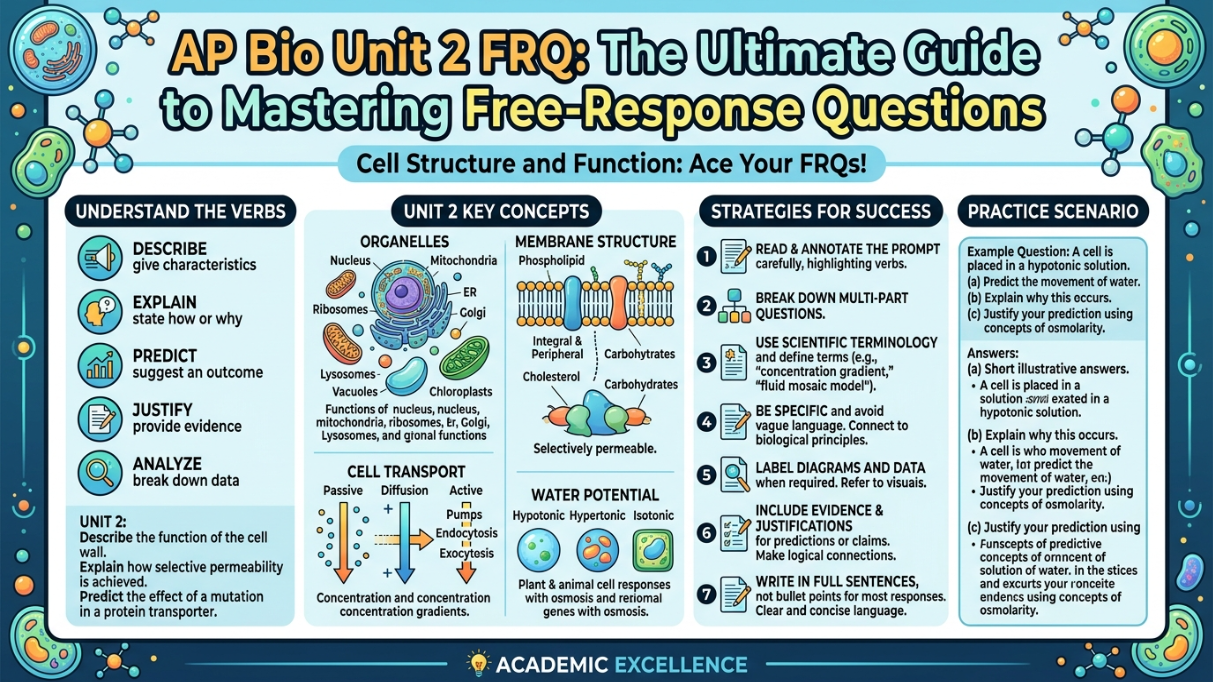

Preparing for the ap bio unit 2 frq can feel challenging because these questions require more than memorizing vocabulary. They test your ability to analyze biological data, explain scientific concepts, and connect multiple ideas into well-supported responses. Students who understand both the content and the scoring expectations consistently earn higher marks.
This comprehensive guide explains everything you need to know about the ap bio unit 2 frq, including common question types, essential biological concepts, proven answering strategies, and practical preparation techniques. Whether you are studying weeks before the AP Biology exam or reviewing the night before, this resource will help you approach Unit 2 with confidence.
Understanding AP Bio Unit 2 FRQ
The ap bio unit 2 frq focuses on Cell Structure and Function, one of the most foundational topics in AP Biology. Students are expected to apply their understanding of organelles, membranes, transport mechanisms, and cell communication while interpreting scientific evidence.
Unlike multiple-choice questions, free-response questions reward logical reasoning and scientific explanations. Instead of selecting an answer, you must demonstrate your thinking, justify conclusions, analyze experimental results, and accurately use biological terminology throughout your response.
What Topics Commonly Appear
Unit 2 covers numerous concepts that frequently appear in an ap bio unit 2 frq. Common themes include membrane permeability, diffusion, osmosis, active transport, endocytosis, exocytosis, compartmentalization, organelle function, surface-area-to-volume ratio, and cellular specialization.
Questions often combine several learning objectives into one scenario. For example, you may analyze laboratory data involving membrane transport while also explaining how organelle structure contributes to cellular efficiency under changing environmental conditions.
How AP Readers Evaluate Responses
AP Biology scorers use detailed rubrics that award points for specific scientific reasoning rather than overall writing quality. Every statement should directly answer the prompt while supporting claims with accurate biological evidence.
Strong ap bio unit 2 frq responses avoid unnecessary information and focus on earning every available rubric point. Clear explanations, precise vocabulary, and logical organization are far more valuable than lengthy paragraphs filled with unrelated facts.
Essential Cell Structure Concepts
Understanding organelles is fundamental because nearly every ap bio unit 2 frq depends on explaining how cellular structures support biological functions. Students should know the roles of the nucleus, mitochondria, chloroplasts, ribosomes, Golgi apparatus, endoplasmic reticulum, lysosomes, vacuoles, and the cytoskeleton.
You should also understand how structure determines function. For example, mitochondrial folds increase surface area for ATP production, while chloroplast membranes organize photosynthetic reactions. These connections frequently appear in explanation-based questions.
Membrane Transport and Cellular Movement
Cell membranes regulate movement through selective permeability, making transport one of the most frequently tested concepts. Passive transport includes diffusion, facilitated diffusion, and osmosis, while active transport requires ATP to move molecules against concentration gradients.
Many ap bio unit 2 frq prompts include graphs, laboratory investigations, or experimental results involving membrane transport. Success depends on accurately interpreting data before explaining the biological mechanisms responsible for observed changes.
Experimental Design and Data Interpretation
Scientific investigations are central to AP Biology. Students should practice identifying independent variables, dependent variables, controls, constants, and potential sources of experimental error while evaluating biological experiments.
An effective ap bio unit 2 frq response often references evidence directly from charts, graphs, or tables before drawing conclusions. This demonstrates analytical thinking rather than simple memorization of biological definitions.
Common FRQ Question Types
Free-response questions come in several formats, each testing different scientific skills. Some require explaining biological processes, while others ask students to predict outcomes, justify hypotheses, or interpret complex experimental data.
The table below summarizes common formats students encounter when preparing for the ap bio unit 2 frq.
| Question Type | Primary Skill Tested | Common Topics | Best Strategy |
|---|---|---|---|
| Data Analysis | Graph interpretation | Diffusion, osmosis | Reference evidence before explaining |
| Experimental Design | Scientific investigation | Membrane transport | Identify variables and controls |
| Biological Explanation | Concept mastery | Organelles, cell communication | Connect structure with function |
| Prediction | Scientific reasoning | Environmental changes | Explain why the prediction occurs |
| Justification | Evidence-based argument | Cellular processes | Support every claim with biology |
Recognizing these formats allows students to quickly identify what each prompt expects. This reduces confusion during the exam and helps organize responses efficiently under time pressure.
Strategies That Maximize Scores
Begin every response by carefully reading the command verbs. Words such as describe, explain, justify, predict, and identify require different styles of answers. Missing these distinctions can cost valuable points even when your biological knowledge is accurate.
A successful ap bio unit 2 frq answer stays organized by addressing each prompt individually, using scientific vocabulary naturally, and supporting every explanation with biological reasoning. Avoid adding unsupported assumptions or discussing unrelated concepts.
Frequent Mistakes Students Make
Many students lose points because they answer from memory instead of responding directly to the prompt. Others fail to connect evidence with conclusions or confuse related processes such as diffusion and active transport.
Another common issue involves incomplete explanations. The ap bio unit 2 frq often awards separate points for identifying a concept and explaining why it occurs. Stopping after the first step may leave easy points on the table.
Effective Study Techniques
High-performing students combine content review with repeated free-response practice. Reviewing scoring guidelines, analyzing sample responses, and comparing high-scoring answers helps reveal what AP readers actually reward.
Rather than rereading notes repeatedly, practice writing complete ap bio unit 2 frq responses under timed conditions. This improves scientific writing, reinforces conceptual understanding, and builds confidence before exam day.
Applying Knowledge Beyond the Exam
Although AP Biology prepares students for a standardized assessment, the reasoning skills developed through free-response practice extend well beyond the classroom. Scientific communication, data analysis, and evidence-based thinking are valuable in university science courses and professional research.
As educator Carl Wieman observed, “Science is not a body of facts to be memorized; it is a way of thinking.” This perspective perfectly reflects the purpose of the ap bio unit 2 frq, which rewards critical thinking over simple memorization.
Conclusion
Mastering the ap bio unit 2 frq requires a balanced combination of conceptual understanding, scientific reasoning, and consistent practice. Students who focus on interpreting evidence, connecting biological concepts, and answering every part of each prompt are well positioned for success.
The most effective preparation includes reviewing core Unit 2 concepts, practicing authentic free-response questions, studying scoring rubrics, and refining written explanations. With deliberate practice and a structured study plan, you can approach the AP Biology exam with greater confidence and significantly improve your performance.
FAQ
What is the AP Bio Unit 2 FRQ?
The ap bio unit 2 frq is the free-response section covering Cell Structure and Function, requiring students to explain biological concepts, analyze experiments, and justify conclusions using scientific evidence.
How should I study for the AP Bio Unit 2 FRQ?
Practice authentic ap bio unit 2 frq questions, review scoring guidelines, strengthen your understanding of membrane transport and organelles, and complete timed writing exercises.
Which Unit 2 topics appear most often?
The most common topics include diffusion, osmosis, active transport, membrane permeability, organelle function, surface-area-to-volume ratio, and cellular compartmentalization.
How are AP Biology FRQs scored?
Each response earns points according to detailed rubrics that reward accurate scientific reasoning, evidence-based explanations, and complete answers addressing every part of the prompt.
What is the biggest mistake students make?
A common mistake when answering the ap bio unit 2 frq is failing to explain biological reasoning after identifying the correct concept, resulting in unnecessary point deductions.
Read More:Disneyland Grad Night 2025: The Complete Guide for Graduating Seniors